Share article
Accra’s Recurring Floods: A Symptom of Deeper Failures
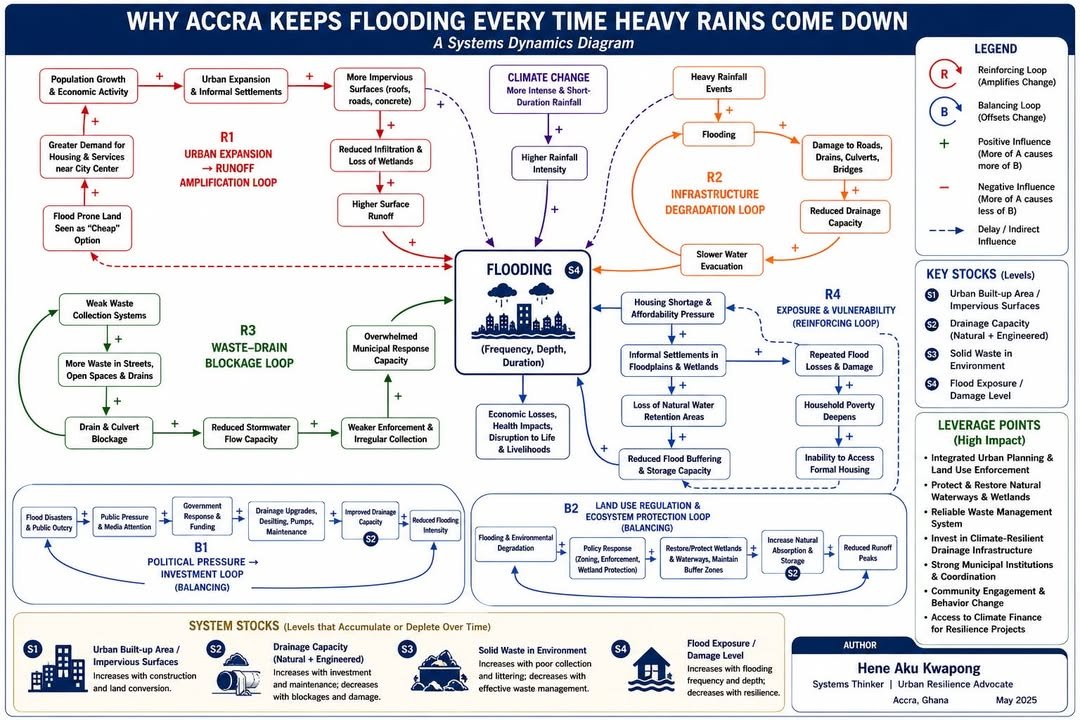
Accra’s perennial flooding is not merely a consequence of heavy rainfall; it is fundamentally a crisis of drainage, land-use planning, and governance. For decades, a confluence of four interlocking failures has exacerbated the problem, creating a cycle of devastation that threatens the nation’s future. While climate change plays a role, it is crucial to understand its position within this hierarchy of causes.
The Four Interlocking Failures
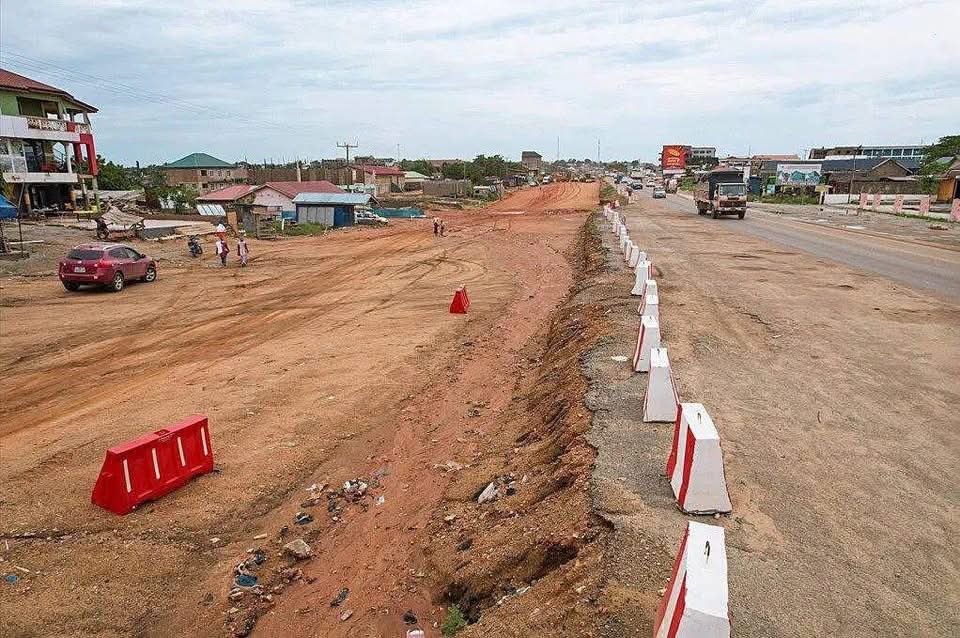
- Unplanned, Rapid Urbanization: Accra’s expansion has largely occurred without enforceable master plans. Informal and often politically sanctioned developments have transformed naturally absorbent soil into impermeable concrete jungles and rooftops. Natural waterways and vital wetlands, which once acted as sponges, have been filled in or built over, drastically reducing the city’s capacity to absorb rainwater. This isn’t a complex mystery; it’s a simple matter of arithmetic: when rain falls on surfaces with nowhere to go, it accumulates on the streets.
- Inadequate and Unmaintained Drainage Infrastructure: Where drainage systems exist, they are often undersized for current rainfall intensities or constructed piecemeal, lacking a cohesive, city-wide network. Many critical open channels, in the absence of effective waste collection, have become illegal dumping grounds. In cities like Accra and Lagos, heavy rains routinely reveal drains completely choked with plastic waste and other refuse. A drain obstructed by rubbish ceases to function as a drain; it becomes a dam, impeding water flow and causing rapid inundation.
- Poor Solid Waste Management: The limited formal waste collection services in many neighborhoods mean that household and commercial refuse frequently ends up in gutters, streams, and culverts. This is the direct mechanism by which moderate rainfall escalates into flash floods: water cannot flow because its path is blocked. This highlights that Accra’s waste problem and its flooding problem are, in essence, two sides of the same coin.
- Climate Change Intensifying Rainfall: Only as the fourth factor does climate change enter the equation. The West African coast is experiencing increasingly frequent short-duration, high-intensity storms. Infrastructure designed decades ago for milder weather conditions simply cannot cope with the volume and intensity of precipitation the atmosphere now delivers. This leads to rapid runoff that overwhelms even existing drainage systems.
It is vital to recognize the order of these factors. Climate change is a real and significant challenge, but it is the fourth problem, not the first. The initial three are direct consequences of governance failures—issues that would still cause floods even if the climate remained perfectly stable. The physical flooding is a stark symptom of a deeper institutional disconnect: the absence of integrated planning that coordinates land use, drainage, waste management, and climate adaptation under a single, accountable authority. Ghana’s leaders often prefer to emphasize the fourth factor because it absolves them of direct responsibility; the preceding three are unequivocally on their ledger.
Singapore’s Transformation: A Blueprint for Change
To understand the depth of Accra’s challenge and the potential for transformation, it is instructive to look at Singapore’s journey. What Singapore is today—a gleaming, well-ordered, prosperous city-state—is a testament to a profound pivot from a past remarkably similar to Accra’s current reality.
In the 1960s, Singapore was far from its modern image. It was a poor, disorderly, and flood-prone city. By its independence in 1965, a significant portion of its population resided in informal, unplanned settlements, or “kampongs,” lacking proper drainage, sanitation, and waste collection. Land development was haphazard, driven by private interests without a legally binding master plan or zoning regulations to protect floodplains. Intense tropical rains routinely submerged parts of the city, paralyzing business and displacing thousands. The Singapore River, like many of Accra’s waterways today, was an open sewer, choked with garbage, silt, and debris.
Flooding in Singapore was not a minor inconvenience but a recurring catastrophe. Historical records detail devastating floods in 1969, 1974, and 1978, resulting in loss of life, destroyed livelihoods, and widespread disruption. The government launched emergency operations, distributing food and providing rent subsidies—a scene eerily reminiscent of Accra’s responses today. Flood gauges, now historical artifacts, once marked the depths of the water on Singaporean streets, serving as stark reminders of a city that once drowned just as Accra does now.
The critical difference is that Singapore decided these gauges would become museum pieces, not operational necessities. This monumental shift was driven by strong political will, integrated urban planning, and a relentless focus on infrastructure development and enforcement. Singapore implemented comprehensive master plans, invested heavily in advanced drainage systems, enforced strict land-use policies, and developed efficient waste management practices. This holistic approach, prioritizing long-term resilience over short-term expediency, transformed a flood-prone city into a model of urban sustainability.
The Path Forward for Accra
Accra’s challenge, though significant, is not insurmountable. Singapore’s experience demonstrates that with decisive leadership, a commitment to integrated planning, and sustained investment, such crises can be overcome. For Accra, the path forward requires:
- Developing and Enforcing a Comprehensive Master Plan: This must include stringent zoning regulations, protecting wetlands and natural drainage paths, and controlling informal settlements.
- Investing in and Maintaining Modern Drainage Infrastructure: This means not just building new drains but ensuring they are adequately sized, interconnected, and regularly cleared of debris.
- Overhauling Solid Waste Management: Implementing efficient waste collection, recycling, and disposal systems to prevent refuse from blocking waterways.
- Prioritizing Integrated Governance: Establishing a single, accountable authority responsible for coordinating land use, drainage, waste management, and climate adaptation strategies.
The floods in Accra are a profound call for systemic change. They demand that the nation confronts its governance failures directly, drawing lessons from cities that have navigated similar challenges. If the flooding doesn’t instigate fundamental change in how Accra plans, builds, and governs itself, the cycle of devastation will continue, threatening the very fabric of the nation’s progress and prosperity.