![NBOSI-01[1]](https://cloudypos.com/nbosi/wp-content/uploads/sites/59/elementor/thumbs/NBOSI-011-rc3u2ljhmnhjs84d8kcrtfc3b1mya82rhqxld85wl8.png "NBOSI-01[1]")


How China Built an AI Chip National Champion
The rise of Cambricon, a Beijing-based company aiming to triple its production of AI accelerator chips, offers a compelling case study in China’s industrial policy and its approach to nurturing national champions in strategic technology sectors. This success story cannot be fully understood without examining the politics of talent within East Asian development states, where the myth of a faceless bureaucracy often obscures a more personal truth.
Across Japan’s MITI era, Korea under Park Chung Hee, or Singapore’s disciplined technocracy, a consistent pattern emerges: states don’t merely fund sectors; they identify exceptional technologists and entrepreneurs, embed them in institutional frameworks, and provide the space and resources needed to build globally competitive firms. China has internalized this lesson with remarkable clarity.
Cambricon’s emergence exemplifies how a modern developmental state strategically empowers specific individuals to spearhead critical industries. In this instance, the catalysts were the Chen brothers – Chen Tianshi and Chen Yunji – two prodigious minds from the University of Science and Technology of China who entered the Chinese Academy of Sciences (CAS) research system as young stars. China’s actions were not accidental but intentional, recognizing that in an era defined by frontier technologies, national champions require elite talent, empowered and protected by the state, rather than emerging solely from bureaucratic directives.
Talent as Strategic Asset, Not Mere Ornament
This point warrants emphasis as it is frequently overlooked in Western analyses. China did not foster Cambricon through brute force. Instead, it meticulously created conditions where exceptional individuals could transform scientific insights into a viable commercial platform. The CAS provided crucial seed funding (around ten million yuan), state-of-the-art labs, reputational backing, and an initial mandate. Subsequently, guidance funds and state-linked venture capital arms supplied the necessary capital runway, while the broader industrial policy ecosystem generated demand.
The strategic decision, however, was to invest in people, not solely in bureaucratic structures. This approach echoes earlier East Asian models. Korea’s “engineers with a mission” era saw Park’s government selecting specific technologists to develop heavy industry. Taiwan’s semiconductor prowess was ignited by a handful of returnees from the United States, explicitly recruited by the state to kickstart the domestic chip ecosystem. Similarly, Singapore’s state machinery has long relied on handpicked technocrats treated as national strategic assets. China is now applying this proven model on a twenty-first-century scale.
The Chen Brothers: Catalysts for Innovation
Within this robust framework, the Chen brothers emerged as the pivotal agents. Chen Tianshi, now CEO, brought the entrepreneurial drive, while Chen Yunji contributed deep research expertise. Their work at CAS provided credibility and a platform to experiment with advanced architectures that, while lacking immediate commercial value, possessed immense strategic potential. When Cambricon spun off in 2016, it wasn’t an act of private initiative in the traditional Western sense; it was more akin to the state launching an arrow it had meticulously shaped over a decade.
As the company matured, it continued to reflect the dual nature of the East Asian model. The founders maintained significant control and steered the technical direction, while the state ensured they had the capital, policy stability, and protected market space to pursue a frontier that would have been nearly insurmountable in a purely competitive global environment dominated by giants like NVIDIA.
This understanding often eludes aspiring economies like Ghana. Development in modern East Asia rarely sprang from diffuse talent pools spontaneously evolving into globally competitive firms. Instead, it arose from the state’s capacity to identify a select group of individuals capable of leading strategic sectors and bolstering them with institutional muscle. China is not improvising; it is consciously following a model that has consistently yielded results for half a century.
Cambricon, therefore, represents more than just a chip company. It is a powerful demonstration of China’s confidence in the East Asian developmental playbook: a state capable of identifying the right individuals, integrating them into the right institutions, and supporting them with the right capital can indeed cultivate national champions, even in industries dominated by entrenched global players. The Chen brothers stand as irrefutable proof of this concept.
In the News Today
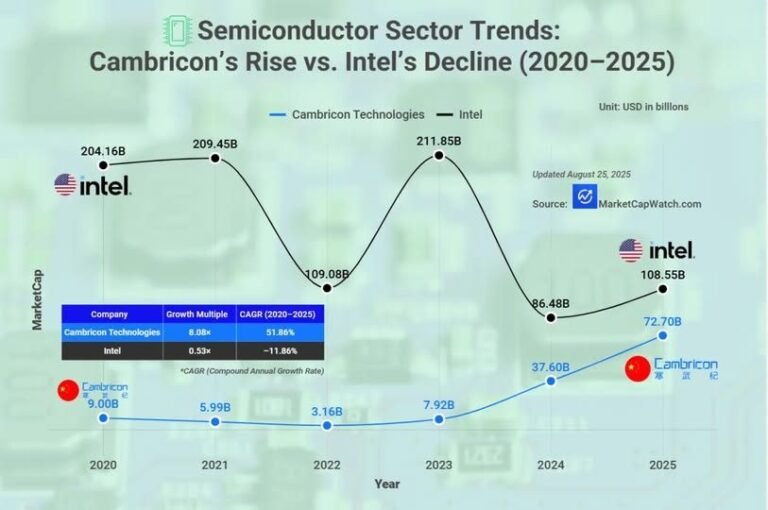
Cambricon is actively positioning itself to fill the void created by NVIDIA’s constrained access to AI accelerator markets in China. Recent statements from NVIDIA CEO Jensen Huang highlight the effective blocking of his company from the Chinese market, raising uncertainties about the acceptance of even its H200 chips should U.S. restrictions ease. Cambricon’s ambition to significantly expand production next year underscores its strategic importance in China’s drive for technological self-reliance.